Do you want to stun audiences with imaginative storytelling and creative prose?
Follow the example of stories that survived centuries, like The Odyssey, Aesop’s Fables, and Shakespeare’s plays. Inject a literary device into your work so the words jump off the page, and readers hang on every one.
What is a Literary Device?

Literary devices are techniques authors use to help tell their stories. Also called narrative devices or literary techniques, these methods of expression make writing more compelling and allow authors to share messages subtly rather than overtly.
Literary Device Example
The beloved simile serves as a simple example of a literary device.
Similes are short comparisons that help readers visualize a scene. They are easy to identify with because they use comparison words, “like” or “as.”
For example, the common saying “busy as a bee” is a simile that compares someone’s activity to that of a bee, highlighting with a visual aid how busy the person is.
25 Literary Devices You Need to Use to Enhance Your Writing

Are you ready to make your writing jump off the page? Incorporate these 25 narrative techniques into your next story for compelling prose that your readers won’t be able to put down.
Metaphor
A metaphor, like a simile, allows writers to make visual comparisons. However, metaphors are less overt. In our simile example above, “busy as a bee,” we aren’t directly calling the person a bee, but we are describing their actions as being similar to a bee.
If we were to change this to a metaphor, we’d say, “you’re a busy bee!”. Instead of comparing someone to a bee, we’re calling someone a bee to demonstrate how busy they are. Because metaphors don’t require direct comparisons, writers can be more creative while using them.
Metaphors can describe a person’s traits, a setting, or even be a stand-in for something else throughout the story. A skilled writer can create an entire story based on metaphor, which readers must read between the lines to understand.
Foreshadowing
When used right, a reader won’t see foreshadowing until after the main event. It’s a clue in the rising action of a story hinting at what will happen without giving it away.
Writing a great foreshadowing sequence is a challenging feat. When it’s too blunt it may give away the climax, but if it’s too subtle readers may never even notice it.
One of my favorite examples of foreshadowing in literature is John Steinbeck’s epic novel Of Mice and Men.
*Spoiler Alert*
Candy, an older man who works on the farm, has a sick dog, Lulu. He knows she needs to be put down, but he can’t bring himself to do it. His boss, Curly, puts her out of her misery, but that makes Candy feel even worse. Later, he tells George, the protagonist, that he should have been the one to do it because a man ought to put down his own dog.
This scene is a fantastic example of foreshadowing because, in the climax, George had to kill Lennie, his mentally disabled best friend, whom he felt responsible for after Lennie accidentally killed Curly’s wife.
Flashback
Get a little creative with time by incorporating flashbacks into your prose. Use it to clarify past events related to the plot or as a tool for character development.
Forrest Gump provides an excellent example of flashback in fiction. For most of the movie, Forrest sits at a bus stop, telling his life story to other patrons through a series of flashbacks.
The literary technique helps ground the viewer in the reality of Gump’s present-day but allows them to explore his story with him.
Plot Twist
Keep readers guessing with plot twists, unexpected events that change the course of a story. A plot twist usually appears with a dramatic reveal, when the viewer realizes that someone they thought was good was evil the entire time, or vice versa.
M. Night Shyamalan is a master of plot twists. Nearly every movie of his contains a plot twist, to the point where audiences try to guess what it is before the big reveal. Shyamalan’s reign as plot twist king started with the 1999 classic The 6th Sense, which revealed that Bruce Willis’s character was dead the entire time.
Poetic Justice
Poetic justice is when someone gets their “just desserts”. It’s a literary technique that allows an author to give someone what they deserve outside the confines of the typical justice system. Poetic justice is typically thought of in the negative, as a criminal getting some type of punishment outside of the law (like dying while trying to kill someone).
A classic example of poetic justice in literature is the fairy tale Cinderella. Most retellings show Cinderella’s stepfamily abusing her and forcing her to serve them. In the end, Cinderella becomes the princess, and her stepfamily is forced into the servitude role.
Poetic justice doesn’t always have to be negative. It can also relate to a protagonist getting exactly what they wanted.
Game of Thrones offers a controversial example of positive poetic justice. John Snow was exiled from the kingdom, but he gained the freedom he craved his entire life.
Red Herring

Handatko via Shutterstock
Authors use red herrings to mislead their audience. It’s a technique explicitly devised to make readers think one thing while something else is happening. Red herrings are used to create mystery, tension, and suspense in thriller and crime novels.
The Harry Potter series abounds with red herrings, but the third book, The Prisoner of Azkaban, provides the best example. Throughout the story, everyone fears Sirius Black, the escaped prisoner on a mission to kill Harry. In the end, a clever plot twist reveals that it wasn’t Sirius, after all.
Red Herrings can relate to plot twists, as in Harry Potter. However, it doesn’t have to be. When they are related, it’s important to remember that the red herrings are the clues that throw people off track, leading up to the plot twist, which is usually a climactic reveal.
Multiperspectivity
Multiperspectivity is a literary technique that allows an author to showcase a plot from the perspective of multiple characters. It’s often achieved by dedicating a chapter to each character’s perspective, but creative authors can accomplish it in a variety of ways.
William Faulkner’s The Sound and the Fury provides one of the best examples of multiperspectivity in literature. This classic novel has distinct chapters, each narrated by a different member of the same family. The various events and views described give a peek into the characters’ inner thoughts as they navigate the same events and times. Some things are left out of one person’s narration but heavily featured in another, showcasing how events impact people differently.
Many crime thrillers may also use multiperspectivity. A detective interviewing multiple witnesses may receive numerous retellings of the same event, as showcased in the classic film The Usual Suspects.
Allegory
An allegory is a type of metaphor, with the story as a whole standing in for something else, rather than a small comparison somewhere in the text. The literary device uses the entire theme and plot of the story as a stand-in for a moral or political theme.
When taken at face value, the story may not seem important, but when a reader digs deeper, they will see that the author was trying to convey an important message.
George Orwell’s Animal Farm provides a wonderful example of allegory used in fiction. The novel, at face value, is about pigs who run a farm. However, the book is really a satire about the Russian Revolution. It showcases how a violent change in society can lead to new authoritarian rulers. An important note is that Orwell himself was a socialist, and the novel wasn’t a commentary on the political system of socialism but more a commentary on the power-hungry corruption present in violent uprisings that don’t take the welfare of the people into account.
Allegory doesn’t have to be as overt as it is in Animal Farm. The Chronicles of Narnia is an allegory for Christianity. Although it’s clear to most adult readers, taken at face value, it’s a fun story about kids traveling to a magical land.
Alliteration
Alliteration is a form of writing that uses similar sounds to create rhythm in the spoken word. It’s commonly found in poetry, but clever use can make novels more compelling as well. The most common form of alliteration is using the same letter to start each sentence, but skilled writers can also expand on that by using similar-sounding syllables.
Tongue twisters are excellent examples of alliteration. “She sells seashells by the seashore” is a tongue twister everyone will remember from childhood. It showcases how alliteration helps poetry stick in our brains.
Many poems also use alliteration to create rhythm and enhance the mood. Edgar Allen Poe uses it in the first line of The Raven.
“Once upon a midnight dreary, while I pondered, weak and weary.”
The use of alliteration and rhyme together creates a natural tempo for the words.
Hyperbole
Hyperbole uses exaggeration to make a point or comparison. Many common similes, like “hungry as a hippo” and “fast like a cheetah,” are examples of hyperbole. It’s obvious that humans can’t eat as much as hippos or run as fast as cheetahs.
Hyperbole is used in literature to help readers visualize an idea and hammer in the point that an author (or character) tries to make. These exaggerated comparisons are often humorous but can convey a breadth of emotions, from sorrow to joy.
Imagery
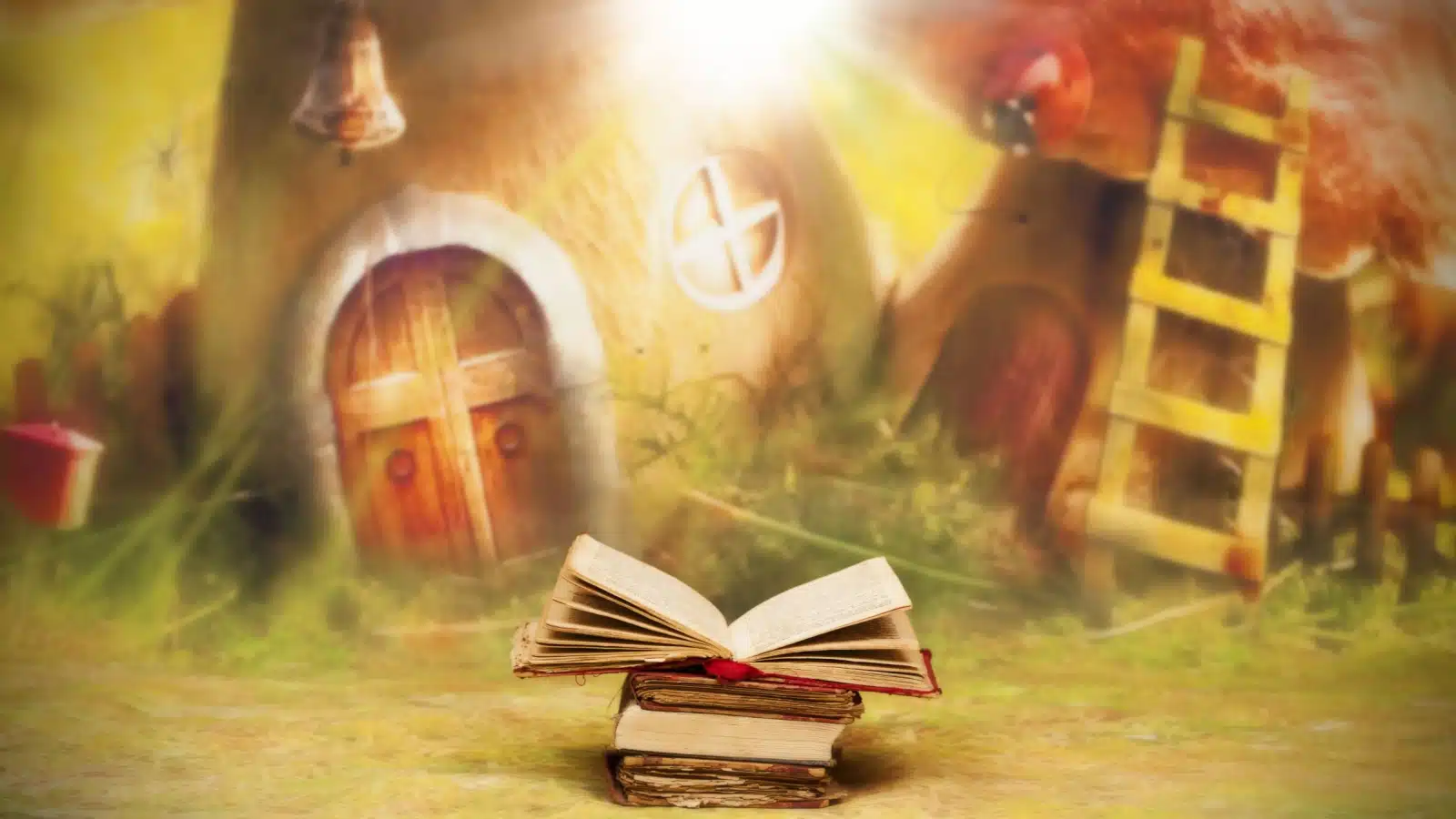
Imagery describes the use of vivid descriptions to help readers visualize a scene or setting. An author may depict a specific item in excruciating detail to make readers feel like they are really there, to help them “see” it.
Imagery isn’t only about sight. A great author will use imagery to play to all of the senses. They will describe how a scene smells, sounds, and feels to truly immerse a reader in the story.
Dickens is a master of imagery. This excerpt from Great Expectations describing Mrs. Havisham’s room is a beautiful example:
“From that room, too, the daylight was completely excluded, and it had an airless smell that was oppressive. A fire had been lately kindled in the damp old-fashioned grate, and it was more disposed to go out than to burn up, and the reluctant smoke which hung in the room seemed colder than the clearer air — like our own marsh mist”
This excerpt gives readers a sense of how the room smells, looks, and feels. It’s dark, and the air is thick and unmoving, providing a sense of age or being stuck in place. Dickens’ clever use of imagery also suggests the mood and attitudes of the character the room represents.
Repetition
Authors use repeating words and phrases for harmony and rhythm or to help readers identify important ideas and themes.
Dickens used repetition in the opening of his famous work A Tale of Two Cities:
“It was the best of times, it was the worst of times, it was the age of wisdom, it was the age of foolishness, it was the epoch of belief, it was the epoch of incredulity…”
Not only did he repeat the different words for time (time, age, epoch), but as these words all have a similar meaning and convey a sense of time, he’s repeating the idea in many different ways to set the scene.
Leitwortstil
Leitwortstil is a German word translating to “leading word style.” As a narrative technique, it refers to the repetition of a word or phrase throughout a work. The repeated phrase generally represents the overall theme of a piece and is designed to make readers remember it. It’s a slightly different form of repetition because the words and phrases aren’t necessarily repeated next to each other but appear numerous times throughout a work.
One of the best examples of Leitwortstil in literature is Kurt Vonnegut’s Slaughterhouse-Five. The novel repeats the phrase, “and so it goes,” broadly throughout the book, making readers consider the overall theme of pre-determined fate versus free will.
Pathos
Pathos is the author’s deliberate use of emotion as a literary technique. Writers who use pathos correctly can invoke joy or sorrow, passion or apathy. It’s used to inspire or instill fear and is a powerful way to connect with readers and send a message.
The iconic speech in the film Braveheart is an excellent example of pathos. The speech inspires the Scottish people to fight for their freedom while energizing and persuading the audience.
“Run, and you’ll live – at least a while. And dying in your beds many years from now, would you be willing to trade all the days from this day to that for one chance, just one chance to come back here and tell our enemies that they may take our lives, but they’ll never take our freedom!”
Pathos is easier to portray in a film than in writing, as actors can use tone and non-verbal cues to convey emotion. However, the words matter too. Skilled authors can use repetition, imagery, and powerful words to invoke emotion in their readers.
Satire
Satire uses humor and irony to showcase the problems inherent in a specific viewpoint, policy, stance, or culture. Satire in literature is typically used to comment on political policy or cultural traditions.
Jonathan Swift’s A Modest Proposal provides an excellent example of literary satire. This essay tries to persuade the audience that poor children should be sold as food for the rich. It’s evident that Swift doesn’t really want to turn to cannibalism to solve society’s problems, but the exaggeration is used to showcase the horrible way the British ruling class had been treating Irish settlers.
Satire can take policy ideas and exaggerate them to the extreme to showcase the worst possible outcomes, which makes it a wonderful literary device for social commentary.
Irony
Irony is when something happens that’s nearly the opposite of what was expected and intended, often in a darkly humorous way. In addition, irony can refer to cases where the literal meaning of something is the opposite of what it really means.
The Gift of the Magi by O. Henry offers a compelling example of irony in fiction. The classic Christmas story follows a poor couple trying to find the perfect gifts for each other. They each sell their most prized possessions to buy a gift for the other. In the end, they learn that the new gifts are unusable because both relate to the prized possession sold.
Although usually read with an uplifting theme about sacrificing for the one you love, it’s also an ironic story because neither can use the gift the other gave up everything to give.
Anthropomorphism
Anthropomorphism gives animals human traits and characteristics. Many children’s books and fairy tales use animals as stand-ins for humans to make the morals easier to understand without portraying actual people.
Disney is notorious for using anthropomorphism in film. Movies such as Bambi, Cinderella, and The Fox & the Hound all feature animal characters acting like people.
Aesop’s fables also use anthropomorphism to highlight their moral message. The fox, rather than a human, gets upset at what he can’t have. The grasshopper, not a person, gets hurt by his lack of proper planning.
These animals are stand-ins that allow a message to get across clearly without the extra nuance needed to explain human behavior.
Pathetic Fallacy
Pathetic fallacy gives human emotions to inanimate objects or animals. This literary device is often used to help a reader see into the mind of a character or to help a reader visualize a scene.
An angry sea, the joyful flowers, and the gloomy sky are all examples of pathetic fallacy, where we assign human emotions to things. These emotional descriptions help set the stage for how the characters are feeling and help convey a certain mood.
Personification
Personification is closely related to pathetic fallacy. It’s a literary technique that gives animals and inanimate objects human actions, traits, and characteristics. Pathetic fallacy is a type of personification limited to emotions and feelings.
An example of personification would be “the joyful flowers mocked him with their dance, happily swaying in the breeze without a care in the world.” The flowers are assigned human actions and emotions in this sentence to showcase the character’s feelings.
Symbolism
Symbolism is using something, like a person, object, or even word, to represent something else. In literature, symbolism is often used to help an author convey a deeper meaning or message in a work.
Humans use a variety of symbols in everyday life to convey meaning. A wedding ring is a typical example that represents a commitment. Red roses symbolize passionate love, while water means life.
Authors use many of the symbols already present in our cultural understanding to convey messages about the character’s state of mind and what is going on in a story, and to enhance the message of the work as a whole.
A great example of symbolism in film is at the end of Disney’s The Lion King. After Scar is defeated, Simba climbs Pride Rock as the rain cleanses the Pride Lands and washes away the death and decay that Scar’s reign wrought. The rain symbolizes the fresh start that will come with Simba’s reign.
Allusion
An allusion is an indirect reference to an object, place, idea, or person. Writers use allusion to make readers think of something that wasn’t directly mentioned.
We often use allusions in everyday speech. Phrases like “the weight of the world is on his shoulders” or “chocolate is my kryptonite” are allusions to works of fiction (The Greek myth of Atlas and the more modern Superman).
Allusion is often used as an easter egg to the audience. The long-running show Supernatural mastered the art of allusion. A season 2 episode featured a guest appearance by Linda Blair, the star of the horror classic The Exorcist. At the end of the episode, Dean remarks that he craves pea soup, a reference to a pivotal scene in that movie.
A season 12 episode opened with Dean carrying a baseball bat wrapped in barbed wire. Dean remarks, “Dad would have loved this!” as an allusion to The Walking Dead, where the actor who plays their father plays a villain with the same weapon.
Onomatopoeia
An onomatopoeia is a word that sounds like what it is describing. Words like “bam!” and “bang!” are descriptions of banging noises, for example.
Writers use onomatopoeia to add rhythm or appeal to various senses. The sizzling bacon elicits more emotion than the hot bacon, for example, because it creates more of a scene. You can hear and see the sizzling bacon, which helps immerse a reader into a scene.
Idiom
An idiom is a common saying with a different meaning than the words typically have. For example, the common phrase “let the cat out of the bag” means telling a secret, which is vastly different from the literal meaning of the sentence.
Authors use idioms to add flavor to their writing. The sentence “it’s raining cats and dogs!” evokes far more emotion than simply saying, “it’s raining hard.” Idioms make language and writing more exciting and thus hold the readers’ attention.
Shakespeare was a master of idiom, and many common phrases we take for granted originated in Shakespeare’s plays. Sayings such as “wearing your heart on your sleeve,” “green-eyed monster,” and “catch a cold” all originate in Shakespeare’s work.
Vernacular
Vernacular is about using everyday speech rather than formal language. Vernacular includes using words, phrases, and dialect common to the region where the story takes place to add a layer of authenticity to a tale. It consists of the use of slang and colloquialisms and is often used to make the characters seem more realistic and immerse the reader in the setting.
Science fiction and fantasy writers may even make up their own vernacular as part of world-building. Certain races may have their own dialects or idioms, which can help readers feel like these different societies are real.
Juxtaposition
Juxtaposition is placing two objects, places, or ideas next to each other to showcase how they contrast. It’s often used in art by placing a bright color in the foreground and contrasting opposite colors in the background.
Its use in literature highlights the differences in settings. For example, the entire novel A Tale of Two Cities uses juxtaposition to highlight the differences between Paris and London during the French Revolution.
Juxtaposition is often used for social commentary or to make a political statement. Comparisons between the very wealthy and those living in poverty, as seen in the Hunger Games, can appeal to the reader’s emotions and showcase the stark reality of the world in new and interesting ways.
More Literary Devices
These 25 literary devices are just the tip of the iceberg. You don’t need to use all of them to tell a compelling tale, but you should pick a few depending on the writing style. Poetry may allow for meter, prose, or rhythm in ways that novel writing often prohibits, for example.
We picked these 25 because they’re easy to understand and can be used in nearly any type of writing. They will help you craft a story filled with descriptive language that readers can’t resist. In addition, they aren’t overly complicated, making it easy for writers to implement.
FAQs About Literary Devices

Literary Devices vs. Literary Elements
Many use the terms “literary device” and “literary element” interchangeably, but they are different. A literary element is something that every story has. It’s a requirement. Every story must have a character; for example, thus characters are literary elements.
A literary device is a narrative technique that an author can use but doesn’t have to use. An author can use a combination of literary devices to tell a tale or none at all. They are optional, but most authors choose to use them to make their writing more creative and less obtuse.
Literary Devices, Literary Techniques, Fictional Techniques, and Narrative Techniques
You may have heard these different terms thrown around when discussing literature and writing. These terms are used interchangeably.
How Do You Identify a Literary Device?
Some literary devices are easy to identify, while others take a more analytical look at a work. The easiest way to think of a literary device is something added to the story for the reader’s sake.
These narrative features would be absent if the story unfolded in real-time in the real world. They are in the story to make it easier to read and understand, create tension or emotion, or make the story more interesting.
Give Your Story Flair with Literary Devices
Are you ready to kick-start your writing? Start using these literary devices to add flavor to your story and engage all of the readers’ senses. If you do this, you can create an epic story, leaving your readers wanting more and more.
For more help crafting your perfect story, grab our creative writing prompts bundle. These prompts will guide you through storytelling in three genres, then help you subvert expectations to create a more compelling tale.