

Goal setting is a vital step in achieving your dreams.
Setting goals helps you define what you want, motivates you to stay on track, and grants a sense of accomplishment when you achieve your desired outcome.
But it’s not as simple as it seems.
Goal setting is far more than a lofty statement. It’s a process that ensures you can achieve the things you want.
I’m a certified life coach, and I’m here to help you discover why goal setting is crucial to a happy life and how to set the right goals to achieve your dreams.
Why Goal Setting Matters

How will you know whether you have what you want without goals?
Goals help us define our hopes and dreams. They inspire us to keep trying, even in the face of adversity.
Setting a goal gives us something to aspire to. It helps us grow and improve, keeps us focused, and ensures we’re on track to achieve our dreams.
Goal Categories

Goals come in various categories, as most people have specific desires for the different parts of their lives.
Before you start setting goals, you need to understand these different categories so you can better align your goals with your life.
Financial Goals

Financial goals encompass all things money. They include retirement savings, big purchases like a house or car, paying off debt, and increasing savings.
If your goals involve money, they are financial goals.
Career Goals

Career goals encompass all the things you want to achieve at work. Consider your future career prospects, projects you want to lead, and benchmarks you want to achieve.
Social Goals

Do you want to get married, have kids, or spend more time with elderly relatives? All of your goals related to a healthy social life can fall under social goals.
Self-Improvement Goals

Our desire to consistently be better than we were yesterday is one of humanity’s greatest strengths.
Self-improvement takes many forms. You may want to learn new skills, enhance the ones you have, get fit, or advance your education.
Spiritual Goals

Spiritual goals encompass anything from attending your chosen worship service more often to engaging in a meditation practice. Anything that enhances your spiritual wellness can fall here.
Health & Wellness Goals

Diet, exercise, and prioritizing your health all fall under the health and wellness goals.
Life Goals

All your lofty “I want to…” that don’t fall neatly into the other categories can fall under life goals.
You may want to travel to every continent, master a craft, climb a mountain, or run a marathon. Life goals are the fun extras that spice up your life.
How To Set Goals You Will Achieve

“A goal without a plan is just a wish” – Antoine de Saint-Exupéry
If you don’t have an action plan to achieve your goal, you’re not really setting a goal; you’re making a wish.
“I want to be an artist,” you muse, without any thought to how you can achieve your dream.
That’s not a goal.
A goal is something you’ve thought about and planned to achieve. Here’s how to set one.
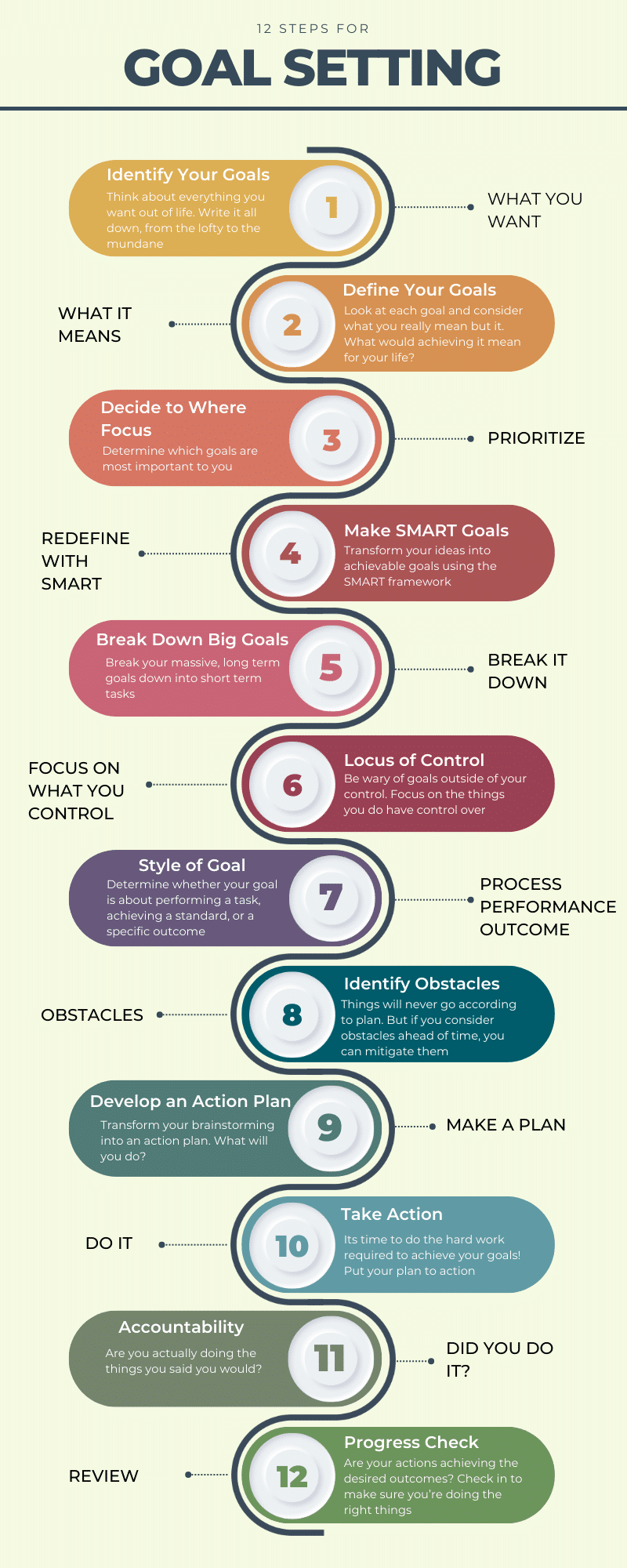
Identify Your Goals

The first step is identifying your goals. Take time to think about everything you want out of life. Write everything, from your most epic life goals to your mundane career goals.
Consider all the different facets of your life, and determine where each goal falls.
During this step, it’s okay to have lofty, abstract goals in numerous areas. We will refine them later.
Define What Your Goal Means

It’s time to transform those abstract goals into something meaningful. Deep dive into each goal and discover what it really means to your life.
Would you have to sacrifice things you want to achieve the goal? Would it require work that you aren’t willing to put in or time you don’t have?
Here’s where we separate our dreams from reality. You may long to be a musician, but you probably won’t get good enough to play if you don’t have time to practice. Perhaps you can refine your musician goal into something more accessible, like learning to play your favorite instrument.
Take the time to examine each goal and determine what achieving it would mean for your life.
Decide Where to Focus

If you’re like me, you have hundreds of life goals. Unfortunately, our time is limited, and we probably can’t achieve all of them.
We don’t have time to learn two instruments and six languages while climbing the corporate ladder and staying at home to raise the kids. There aren’t enough hours in the day to have it all.
It’s time to prioritize.
Pick one or two goals in each category that mean the most to you. Those are the goals you should focus on.
Use the SMART Goal Method

Now that we’ve prioritized our goals, we need to redefine them using the SMART goal method.
SMART is an acronym that helps you set the right goals. SMART goals are Specific, Measurable, Achievable, Relevant, and Time-based.
When setting goals, you should aim for these five benchmarks.
SMART Goal Example

Let’s say you have a goal to retire early. Is it a SMART goal?
It’s measurable because we know the traditional retirement age is 65. However, it’s not specific because you haven’t laid out any benchmarks. We have no idea whether it’s achievable because we don’t know what “retire early” means. You didn’t set a time frame—we don’t know if you want to retire at age 60 or 45.
This goal is more of a wish, but if you transform it into a SMART goal, you’ll be in a better position to achieve it.
To redefine the wish as a SMART goal, we’d want to define exactly how much money we will have and when we will retire.
“I will retire at age 45 with 1 million dollars in investments” is a SMART goal, depending on your circumstances. We still need to know whether it’s achievable. If you’re 40 years old and have no money in investments, it’s unlikely that you’ll achieve the goal. However, if you’re 25 and debt-free with a high salary, it works as a SMART goal.
It’s time to look at the goals you’ve prioritized and redefine them using the SMART goal framework.
Break Big Goals Down

Many of us have massive, long-term goals that seem impossible to break down into the SMART framework.
Most of these long-term dreams can be broken down into manageable bits.
Let’s revisit the “retire early” goal and break it down into achievable SMART goals.
What age do you want to retire? How much money do you need to save/invest to accomplish that? What steps must you take to earn that money?
Your new, smaller goals may have little to do with retiring early on the surface. You might develop a monthly savings or debt repayment goal to put yourself on the right path, or you may discover you need to make more money and focus your goals on increasing income.
Breaking a massive goal down into increments will make it easier to achieve.
Maintain a Locus of Control

One of the biggest mistakes people make with goal setting is forgetting about the locus of control. They set massive goals entirely dependent on outside circumstances, then feel demotivated when they don’t come to fruition.
You can’t set a goal you have no control over.
Many people want to get married and have kids. They’ll say things like, “I will be married by 30,” even though they’re 28 and single.
That’s not a good goal because you can’t force someone to marry you. You must set goals you can control.
Think about the things YOU can do to make your goal a reality. You might need to focus on self-improvement to become a better partner or put yourself out there in the dating scene.
No matter your goal, there are things you can control and things you can’t. Focus on goal setting for the things you can control.
Determine What Style of Goal You Need

We don’t always have as much control over our goals as we’d like, but setting the right kind of goal can help.
You can set three styles of goals depending on how much control you have: process goals, performance goals, and outcome goals.
Process Goals

Process goals are the easiest goals to achieve because we have the most control over them.
Process goals are achievable as long as we perform specific steps. If we do the thing, we will achieve the goal.
An example of a process goal is a monthly savings goal. For example, you can set a goal to save $200 per month in a high-yield savings account. All you have to do is set aside the $200, and you’ve achieved the goal.
Think of a process goal as a behavior you must do to help you achieve your long-term goals.
Performance Goal

A performance goal is a standard that you want to achieve. Although it might go hand and hand with your process goal, it’s usually the result you wish to achieve from the process goals.
Your performance goal, which complements the $200 per month savings goal, might be to save $2500 by the end of the year.
It’s a longer-term goal with an achievable standard.
Performance goals are harder to achieve than process goals because although they are still mostly within our control, unexpected events can affect our performance.
Outcome Goals

Outcome goals are more difficult because not every part of them is in your control.
Sticking with the early retirement analogy, your goal might be to increase your net worth by 10%. Part of this is in your control, as your process and performance goals relate to saving money.
However, some of it is outside your control.
The stock market might experience a downturn, or you might have a financial emergency that impacts your savings.
It’s okay to set outcome goals, but it’s crucial to remember that sometimes, things happen outside of our control. Do the best you can, and accept that not everything works out the way you expect all the time.
Identify Potential Obstacles

Life isn’t smooth sailing. There will be bumps along your road, and that’s okay.
Working to identify them upfront will prepare you to face them.
If we return to the early retirement goal, we can identify numerous potential obstacles. The market may not perform as you expect. You may lose your job or experience a pay cut.
Although you can’t always control these things, you can identify them as potential obstacles to achieving your goal and think about ways to mitigate them.
Develop an Action Plan

“Those who fail to plan, plan to fail”
It’s time to transform all your brainstorming into an action plan.
Armed with your SMART goals, you must define the steps you need to take to turn your goals into a reality.
Break your goals down into specific tasks. Decide when and how you will accomplish them.
For example, if your SMART goal is to lose 20 lbs in the next year by working out twice a week, break it down. What do you need to work out twice a week?
Do you need a gym membership or workout equipment? Where will you work out? What types of exercises will you do? How will you manage conflicts with your workout schedule? Who will you include? What days/times will you be working out?
Break every little aspect of your goal into an achievable task.
Use a Template
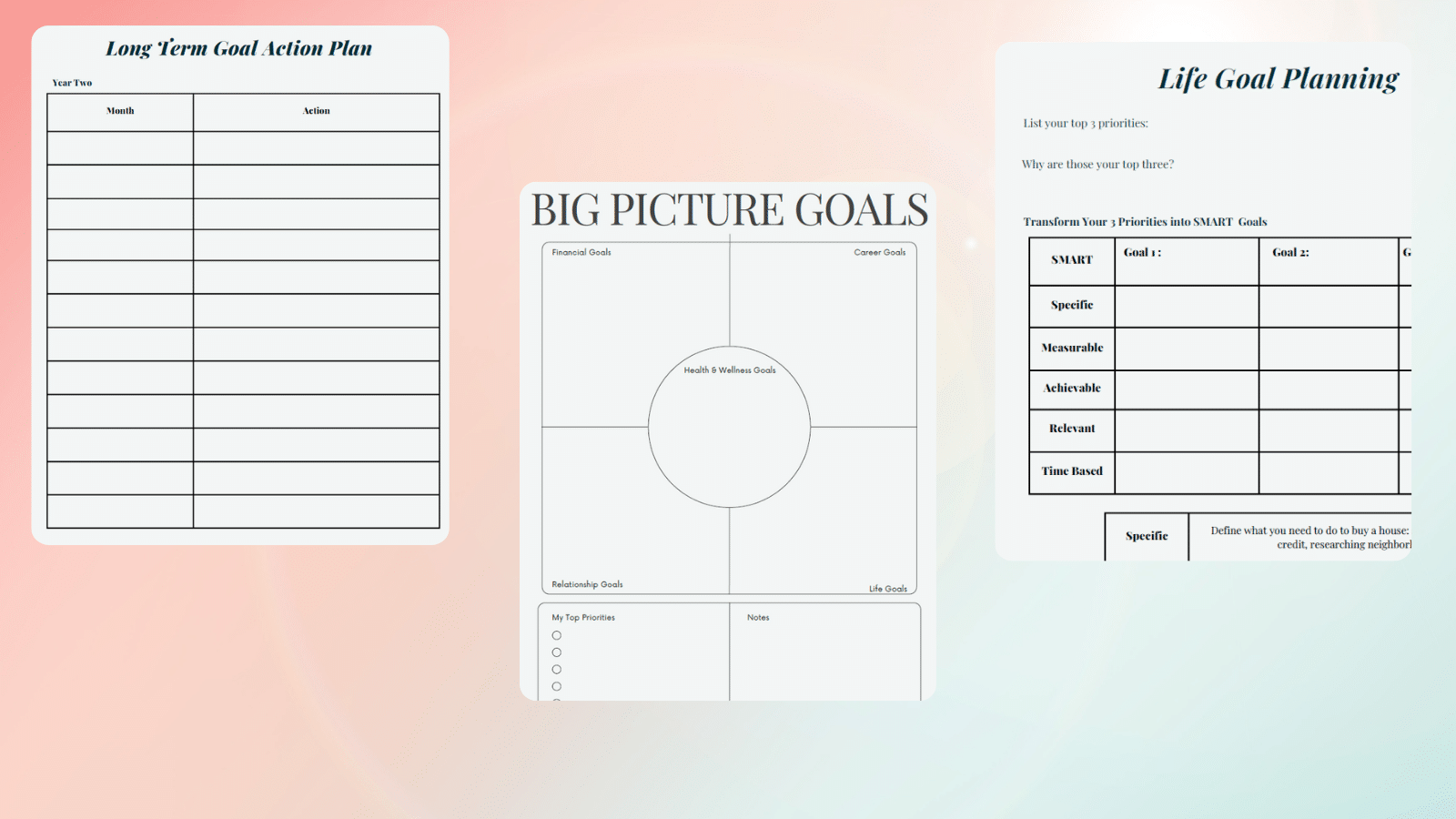
Need help making an action plan?
Use an action plan template!
These are pre-made printables that help you write out your goals and guide you toward developing a plan to achieve them. Although you can find action plan templates all over the internet, why shop around when the best is right here?

We created a 17-page printable action plan template bundle bursting with resources to help you achieve your goals.
🌱 What Our Action Plan Template Bundle Helps You Do
✔ Clarify what you actually want (and why)
✔ Turn vague goals into realistic, achievable plans
✔ Break big goals into manageable steps
✔ Track progress and momentum at a glance
✔ Decide what to do next—every time
✔ Stay aligned with your values as life evolves
Grab it at our store for only $3.97!
Take Action

You will never achieve your goals if you spend all your time planning how to achieve them. Acting on your goals is vital, yet many people freeze here.
You must take action.
It’s time to grab your gym bag and go twice a week as you planned. It’s time to examine your budget and cut unnecessary spending.
If you want to accomplish your goals, you must do the work you promised yourself you would do.
Maintain Accountability

You’ve made an action plan, but are you actually doing the things you said you’d do?
Are you going to the gym twice a week or looking for a side hustle?
If you’re struggling, consider getting an accountability buddy who has similar goals. Knowing someone else will hold you accountable can help you stay on track.
Conduct Reviews

Sometimes, things don’t go according to plan. We must review our actions regularly to ensure we’re inching closer to the goal.
Conducting reviews gives us the opportunity to examine whether our actions are working and make adjustments if they are not.
For example, if “putting yourself out there” isn’t helping you find a relationship, you may need to look at the places you’re “putting yourself.” Are you lazily swiping on dating apps, hoping a date will fall into your lap, or did you join hobby groups to meet people with shared interests?
If you’ve been going to the gym twice per week but haven’t lost a pound, you may need to go three times a week or make adjustments to your workout routine.
You should conduct quarterly reviews of your goals to ensure that your actions are putting you on track to achieve them and that the goals are still what you want.
How To Achieve Your Goals

We’ve laid out the steps you must take to achieve your goals, but sometimes, we need more than that.
Here are some tips to keep you on track.
Mindset

First, you must shift your mindset.
You must WANT to achieve your goal and KNOW you can do it.
A lot of that comes down to mindset. If you believe you can, you can.
Visualization

Sometimes, it helps to visualize yourself having achieved your goal. Create a vision board showing yourself doing the work it takes to succeed or showing the version of you who has accomplished the goal.
Setting Intentions

Setting a daily intention can help you get on the right path to achieve your goal.
Your intentions can be broad, like “I will work towards my goals today,” or specific, like “I will follow up on three leads today.”
Setting these daily intentions is a promise to yourself that you will do what you set out to do.
Planners

OlgaPS via Shutterstock.com.
Hey folks! Transparency Disclosure- Some of the links in this article are affiliate links. That means I’ll receive a small commission if you decide to click on it and buy something. Don’t worry, it doesn’t cost you anything extra!
I can’t achieve anything without my planner. It helps me keep track of everything I need to accomplish each day, week, and month.
Having everything written out in an accessible plan ensures that I will do what I need to do when I need to.
Ivory Paper Co has an amazing all-in-one planner with a daily, weekly, and monthly section that allows you to track your short—and long-term goals simultaneously.
You can explore all my favorite planners here!
Staying Motivated

Keeping our eyes on the prize is hard when our long-term goals are years away. You must find ways to stay motivated.
Consider getting an accountability buddy or coach to help you stay on track. Reward yourself for passing milestones. Visualize your life once you accomplish the goal. Use whatever motivation techniques work for you to keep yourself on target.
Goal Setting Today – Goal Accomplishment Tomorrow

The sooner you set your goals, the sooner you will achieve them. Examine your hopes and dreams and start setting goals to achieve them!
You’ll be surprised at what you can accomplish when you put your mind to it.