

Are you passionate about creative writing, longing to craft the next great American novel?
To transform that goal into reality, you must learn how to grab an audience and keep them hanging on your every word in titillating anticipation of what comes next.
It starts with a compelling rising action sequence.
What is Rising Action in a Story?

Handatko via Shutterstock
The dictionary defines rising action as “a related series of incidents in a literary plot that builds toward the point of greatest interest.”
To break it down, rising action is the part of the plot leading up to the climax.
In a great story, the rising action builds suspense, keeping audiences on the edge of their seats, teetering with excitement about what might happen next.
Rising Action is a Plot Element
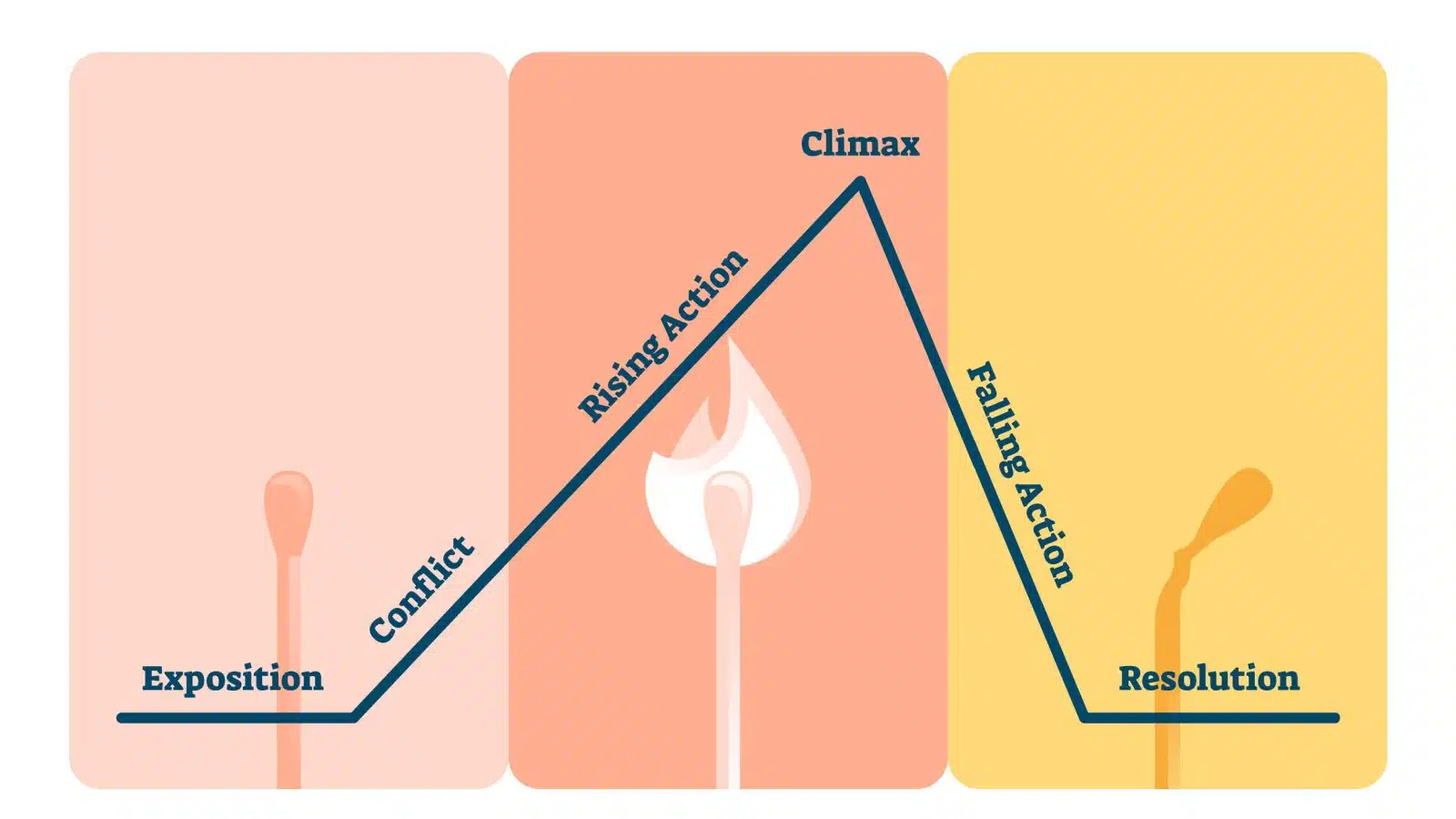
The rising action sequence is only one of five crucial plot elements. Writers must understand each one as they flow together to form a cohesive narrative.
- Exposition: A story’s opening that sets the stage for all that comes next
- Rising Action: The action sequence leading up to the climax
- Climax: The story’s primary conflict/action sequence; the peak
- Falling Action: The action sequence leading to the resolution
- Resolution: Tying up loose ends and closing the story
The plot is only one of the seven literary elements needed for a story. Although a compelling plot with suspenseful rising action is vital for a great tale, if that’s all you have, your story will fall flat.
You must consider all seven literary elements when writing your novel:
- Plot
- Character
- Narration
- Point of View
- Theme
- Setting
- Tone
These elements should intertwine with your rising action sequence.
Rising Action Examples

Every work of fiction has rising action, from simple tales to epic fantasy quests.
Here are two examples from each end of the spectrum to help you get an idea of how it works.
Rising Action in Hansel and Gretel
Short fairy tales are the easiest to dissect for examples of various plot elements. To highlight rising action, we’ll use Hansel and Gretel.
The popular children’s tale follows two children who happen upon a witch after getting lost in a forest. The rising action starts after the exposition, which explains the situation.
In the first plot element, we learn that Hansel and Gretel are brother and sister, and their family is so poor that they can’t feed the kids.
Next comes the rising action. It includes everything that actually happens, starting with the mother (usually described as a step-mother) whispering to the father that he should ditch the kids, the father’s first attempt, which is foiled by Hansel’s stone trail, and the second attempt, where the birds eat Hansel’s seed trail. The sequence also includes the children’s activities upon finding the witch’s house, and most of what befalls them in captivity.
The rising action ends when the climax begins, with the children fighting back against the witch, pushing her into her own oven.
As you can see, the rising action fills the majority of the story. It must be compelling enough to keep the reader engaged.
Rising Action in Star Wars: A New Hope
The first Star Wars movie provides an excellent example of rising action in modern fiction. Luke’s journey to find R2D2 after the droid runs off, the attack on his family, the escape from Mos Eisley, and the dramatic rescue of Princess Leia on the Death Star are all components of the movie’s rising action.
Although the battle between Obi-Wan Kenobi and Darth Vader on the battle station may seem climactic, it sets the stage for the later space battle and Luke’s growth into the hero he needs to be.
It’s all part of the rising action.
The Star Wars example shows that rising action can include heart-pounding action sequences and essential plot points that move the story forward toward the ultimate climax.
How to Start Your Rising Action Sequence

There’s no hard and fast rule when the rising action starts in a story. It typically begins immediately after the exposition, but not always. Some authors flow between exposition and rising action, offering a little bit of tension and moving the plot forward while setting the stage.
Stories that follow multiple characters in multiple settings may have numerous sequences of exposition and rising action.
Start By Doing
One of the essential rules of literature is to “show, not tell.” Therefore, rising action should start with your characters doing something rather than explaining something.
Start with action.
Have your characters do something that moves the plot forward. They’re embarking upon their journey, picking up the life-changing book, or meeting the person who will guide them toward their destiny.
It doesn’t have to be epic. Not all stories are hero-tale fantasies. Dramas, mysteries, love stories, and other genres can begin with subtle actions, like reading a love note, heading to work, or taking the dog out for a run.
Let your plot outline guide your rising action.
Key to a Great Rising Action Sequence

Rising action builds suspense for the climax. If you want to write an epic rising action sequence, you need to be on point with your suspense-building.
What is Suspense

Suspense is tension. According to Masterclass, it’s that uneasy feeling an author creates in readers when they aren’t sure what’s coming next in the story.
Suspense creates an atmosphere where readers can’t wait to see what happens next.
How to Build Suspense
Building suspense is an art. You want to entice your readers, keeping them excited to discover what happens next. However, you can leave your audience frustrated if you never answer any questions. On the other hand, if you give out too much information too soon, your story can get boring.
There are many ways to build suspense that aren’t related to the rising action. Character development, setting, world-building, and other story elements play a role in creating tension. Plot elements are a small but vital part of building tension.
Here are tips for creating tension with plot elements during the rising action.
Use Cliffhangers
Cliffhangers are a literary device used at the end of chapters, shows, and first parts that leave audiences asking:
“Oh my god, what will happen??”
Imagine watching a television show, and the main character falls off a cliff at the end of the first episode. She grasps the cliff edge, dangling on the precipice of disaster, and the show cuts to black.
What happened?? Did she fall? Can she pull herself back up? Audiences must know, and they’ll tune in next week to find out.
Drop Clues
Nobody likes stories where a climax comes out of nowhere. Even in stories with an epic twist, the climax shouldn’t be a complete surprise.
The rising action should have little hints and clues about where the plot is going. Drop little hints and clues along the way. It’s okay to use devices such as red herrings to keep them guessing, but there should always be a way to connect the rising action to the ultimate climax with your little clues.
Create Subplots

The main plot must be engaging in and of itself, but subplots help hold readers’ attention along the way.
These smaller plots aren’t explicitly related to the overall storyline but offer additional ways to grab readers’ attention throughout the tale.
Subplots may involve drama between characters, a vital mission for a secondary character, or conflicting priorities that divide a main character’s attention.
Put Characters Under Pressure
Pressure builds suspense. The higher the stakes, the more tension in a story, and the more enthralling it will be to readers.
In some stories, you can create pressure in obvious ways. Action movies lend themselves to ticking time bombs that will cause immense damage unless the protagonist can stop them.
Most stories won’t have as high stakes for the world; instead, you can create stakes for the character. Anything that puts pressure on the character’s inner world can build suspense.
A drama may feature a character threatening to lie about an affair, a mystery may have a detective who faces losing her job, and a romance may include a character pressured to marry by their parents.
Include Obstacles
A great story features obstacles for our heroes to overcome on the way to the central climax. These obstacles are essential for writing a compelling rising action sequence.
The main quest in The Lord of the Rings involves Frodo’s journey to Mordor to destroy the Ring of Power. On the way, the Fellowship must cross Moria, an abandoned dwarven city fraught with dangers. Although the movies made the sequence through Moria a climactic end to the first installment, when viewed as a whole, it’s merely an obstacle on the way to Mordor.
Compelling obstacles like Moria leave audiences craving more.
Write a Page-Turner: Tips for Sucking Your Audience in During Rising Action

Every story is a bit different. Genre plays a significant role in specific guidance for keeping an audience glued to their seats. An epic battle sequence may work to keep readers engaged in a fantasy novel but might be out of place in a mystery set in the mid-1950s.
Here are five general tips for enthralling your audience in any novel. You don’t have to use them all, and you can mold the ones you do pick to fit your story.
Use Literary Device
Literary devices are tools authors can use to enhance their writing and make the story more compelling to readers.
Examples of literary techniques related to the plot include foreshadowing, flashbacks, and plot twists. Use these features to keep your reader intrigued.
Embrace Failure
Characters who always win get stale. Readers love a comeback story. They want to root for an underdog and feel second-hand pride when their hero finally triumphs in the face of insurmountable odds.
Don’t always let your character win when crafting your rising action sequence. Show their failures, their losses, and their suffering. Allow them to make mistakes and learn from them. Use their missteps as plot elements to lead your story to its climax.
Show Don’t Tell
We talked about how crucial it is to show audiences things rather than tell them. Use the rule while crafting your rising action sequence.
Don’t write, “John cried when his dog passed away.” Instead, show the emotion:
“John huddled in the corner, staring at the lifeless body of his beloved companion. Tears streamed down his face despite his best effort to hold them back.”
The show, don’t tell rule applies to action sequences as well as emotion. Describe the actions, movements, and dialogue rather than plainly stating what happened.
Drive the Story Forward
Have you ever read a story that just seems to go nowhere? It gets boring when nothing happens, so ensure you introduce elements and plot points that continuously drive your tale forward.
There are two primary methods of plot progression. You can use characters or plot points.
Plot-driven stories feature inciting events that characters face and have to overcome. Character-driven stories revolve around the characters’ choices and the consequences of those choices.
Many authors use both to drive stories forward.
Develop Your Characters

Although not explicitly related to the plot, character development is essential to every story.
The rising action sequence is the ideal time to develop your characters. Put them in difficult situations and see how they respond. Dig into their backstories, using that as a plot point for their behavior.
Even the most intriguing plots will fall flat if readers don’t care about the characters.
Rising Action versus Falling Action
Rising action and falling action are both essential parts of the story. The rising action leads to the climax, while the falling action releases the tension after the big payoff on the path to resolution.
Falling action may tie up loose ends or follow a journey home. Frodo’s return to Hobbiton, Simba’s ascent up Pride Rock, and Luke and Han’s triumphant return to base after destroying the Death Star are examples of falling action in fiction.
A journey home after defeating the villains, a celebratory party, or a moment of reflection can all be falling action sequences.
Creative Writing Takes Practice
Writing a novel isn’t an easy task. Crafting a compelling story takes work, practice, and patience. Creative writing prompts can help you get the juices flowing, and narrative study can help you develop the building blocks, but the best way to get better at it is to do it.
Need help? Get our bundle!
Grab your keyboard and start typing. Get your story out there. Who cares if your first draft isn’t the best? That’s what editing and revisions are for!
As they say, practice makes perfect; the same holds for writing fiction. Start practicing today and become the great writer you were always meant to be.