
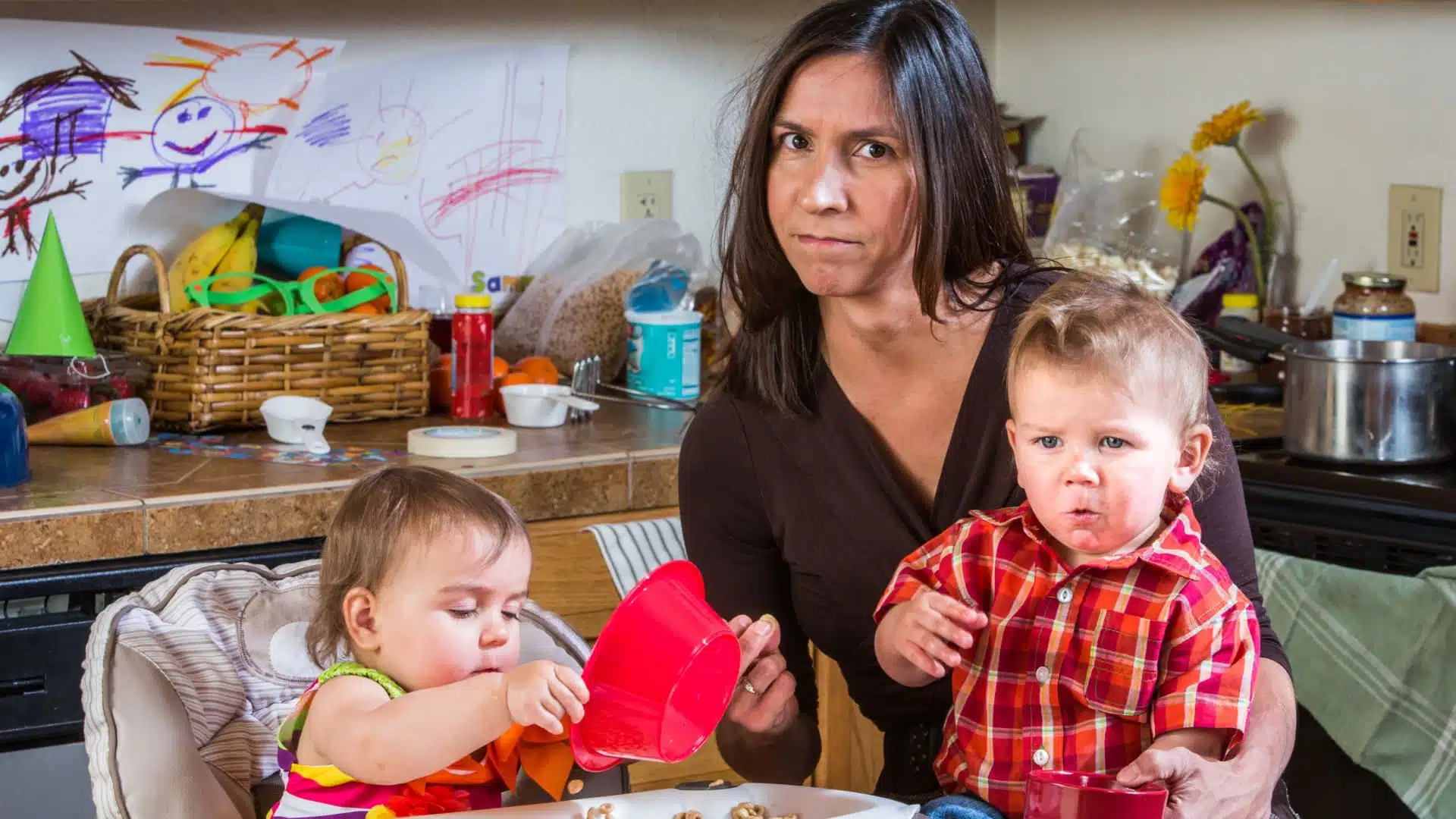
It takes a village to raise a child, but that village is gone.
Today’s parents flock to the internet, lamenting the loss of help and community for child-rearing. They’re stressed and overwhelmed, saddled with the massive responsibility of feeding, raising, and caring for their kids with no support from anyone.
But they don’t seem to realize what the village really was: women’s unpaid labor.
There Once Was a Village

In the not-too-distant past, parents could depend upon a thriving village. Grandmas, aunts, sisters, neighbors, and community organizations split the labor of childrearing.
Grandma would watch the kids while Mom and Dad worked. The church had a rotating schedule of moms watching the kids for the day. Neighbors watched each other’s kids as they ran from yard to yard, gleefully enjoying the freedom inherent in childhood. Teenagers would babysit for pocket cash. Family, friends, and community members would stop by with casseroles or just for company.
All these systems worked together to craft a lovely village of community and support.
That village is gone.
Where Did the Village Go?

Why don’t people help each other out anymore? Why did our little village of people who’d always be there to help disappear?
The harsh truth that no one wants to admit is that the village disappeared because it depended on women’s unpaid labor.
Grandma babysat. A rotating group of moms signed up for daycare. The neighborhood mothers watched all the kids. Teenage girls babysat. Female family, friends, and community members would stop by.
The community’s men rarely contributed to the village.
Women Don’t Have Bandwidth for More Unpaid Labor

Modern women don’t have time to form a village. They work outside the home to support the family and do the bulk of the work at home because their husbands don’t help.
In the meantime, the bar rose for parenthood. If your kids aren’t in ten activities by the time they’re six, you’re a terrible parent. Kids no longer roam the neighborhoods and instead rely on only their mothers for all their emotional, social, and physical needs.
Women are exhausted, but it’s not just that. They’re also starting to wise up to all the unpaid labor they’ve provided to society throughout the centuries and have decided they don’t want to do it anymore.
Women Working Isn’t the Problem

Some claim “allowing” women to work caused the problem and think forcing women back into domestic servitude is the solution.
Of course, those folks only look at how they’d personally benefit from a system that subjugates half the population.
Women need the ability to work outside the home. They need the autonomy to make their own choices for themselves, their lives, and their families. Most importantly, they need the ability to take care of themselves financially should they find themselves widowed or trapped in an abusive relationship.
Everyone should have the freedom to live their lives on their own terms.
In addition, women have always worked outside the home. We pretend that everyone had a housewife in the idyllic 1950s, but that was a privilege reserved for middle-class families and above.
The rest of the women still worked; they just did everything else too. We don’t want to do that anymore.
Society is the Problem

The problem is a society that values work more than families, profit over people, and individualism over community.
We could easily create a village with our tax dollars, but choose not to because we don’t value community.
How to Bring the Village Back

We could bring the village back, if we wanted. To start, we could pay women for domestic labor with a UBI. Offering women a way to support themselves and their families while reestablishing the village we all took for granted would go a long way.
We could also put our tax dollars toward building the community by creating government-funded daycares, community events, and safe spaces for children.
Society Doesn’t Value Motherhood

We don’t do any of these things because we don’t value them.
We don’t value domestic labor. Our society deems “women’s work” useless, easy, and something individuals must handle on their own. That the work includes the essential task of raising the next generation doesn’t seem to matter – if you can’t put a dollar amount on it, it’s not work.
Not only do we devalue domestic labor, we also actively punish motherhood. There’s no prenatal care, no help for the cost of childbirth, and no assistance for childcare, meaning families (mostly mothers) must bear the burden on their own. In addition, we scoff at working moms while deriding stay at home moms, and pretend child rearing isn’t really work. It’s no wonder more and more women are opting out of motherhood.
We Need a Change

It’s time for a paradigm shift. Society must decide what’s more critical – ever-increasing profits or a thriving community. The people who make society or the companies who extract it’s resources.
Unfortunately, it seems we choose profits over people, and the village won’t return until we shift our priorities.