

Financial freedom lets you live the life you’ve always wanted. Freed from the shackles of a meaningless job, you get to do whatever you want, whenever you want.
It sounds like a dream, but with a little hard work and some great planning, you can transform that dream into reality.
What do you have to lose?
Watch the YouTube Video:
What Is Financial Freedom?

To achieve financial freedom, you must first know what it means. Technically speaking, it’s having enough money in savings, investments, and passive income that you don’t have to work a traditional job.
That’s a lot of money, making financial freedom seem like an unattainable dream.
I have a slightly different definition of financial freedom, which makes it more accessible.
Financial freedom is the ability to choose the lifestyle you want because you don’t have to worry about money, whether you work or not.
X-Step Plan to Financial Freedom

Many famous finance so-called gurus will tell you that there is an easy path to financial freedom for everyone. You will achieve liberation if you follow their seven-step plan, 10-step plan, or 12-step plan.
The problem with these plans is that they aren’t realistic. Every single person has different starting points, end goals, circumstances, and obstacles to overcome.
Although these plans have a lot of great content, they’re too rigid. You get the sense that you MUST follow their exact steps in their exact way, and if you don’t and can’t achieve your goals, it’s all your fault.
The ultra-focus on following the “right” path doesn’t leave room for variation. People feel like failures because the plan doesn’t work for them. They can’t seem to escape debt, or they have so many bills they can’t pay anything extra. Nobody considers their needs when designing these X-step plans.
Until now.
We realize that achieving financial freedom isn’t a one-size-fits-all plan, but that doesn’t make it harder. It actually makes things a lot easier.
How to Achieve Financial Freedom

Despite the lack of a simple action plan, there are actionable steps you can take to achieve financial freedom. I call these steps building blocks, because there’s no set path you must take.
You get to create your own road map to financial success, and we will show you how.
It starts with deciding what you want.
Life Goals Vital to Financial Freedom

Financial experts will tell you to examine your budget, income, and financial goals, but they always skip the most crucial component of your financial independence road map: your life goals.
What do you want out of life? What are your personal goals?
Before figuring out the finances, you must decide what you want. Do you long to live in a quaint cabin off the grid, or would you rather have a high-powered career in a bustling city? Do you want to travel the world or retire to your cozy corner of it?
Most expert financial advice assumes that everyone wants to follow the same life script. They’ll go to college, get married, have kids, and then consider retiring.
That’s no longer reality. Life abounds with choices. It offers numerous paths, and the ones you choose will have major impacts on your financial journey and quest for financial freedom.
Determining what you want out of life is the first step to plotting your route to financial freedom.
What Type of FIRE Are You?

You’re reading an article about financial freedom, so we’re assuming your life goals relate to achieving financial independence at some point.
But what does that mean?
Even financial freedom isn’t one size fits all. The idea of financial independence spawned a massive movement with lots of different paths.
Lean FIRE adherents want to homestead and live off the land, while Fat FIRE seekers want all the luxuries in life without the stress of a high-paying job. Barista FIRE lovers want to work part-time for fun, while someone working towards Coast FIRE loves their job and is more interested in the financial security side of FIRE than the freedom aspect.
Before figuring out how to achieve financial freedom, you must determine which type of FIRE you’re pursuing.
Take the Quiz: What Type of FIRE Are You?
Develop Your Financial Goals

Once you’ve figured out your life goals and have an idea of what type of financial independence is best for you, it’s time to map out your financial goals.
Because financial goals vary based on desires, the main question you must ask is “What do I need to do financially to achieve my life goals?”
If your top goal is to build generational wealth for your children, you should focus on funding a 529 college savings plan and buying a home. However, if your greatest desire is traveling the world in an RV, your financial goals will be focused on financing or purchasing an RV and paying for that lifestyle.
If you need help getting started, snag our free Financial Freedom Mind Map. It’s a four-page printable mind map/worksheet that will help you visualize the life you want and take steps toward achieving it.
The 5 Building Blocks of Financial Freedom

One thing that the personal finance gurus get right is that everyone can use simple building blocks to achieve financial independence.
Whether you are saving for a house or an RV, you still need to save money, right? Whether you are investing for a child’s college fund or your retirement, you still need to invest.
Getting your finances in order is the first step to achieving your financial goals, regardless of what those goals are.
There are five main building blocks of financial freedom: creating a financial plan, building a budget, saving, investing, and paying off debt.
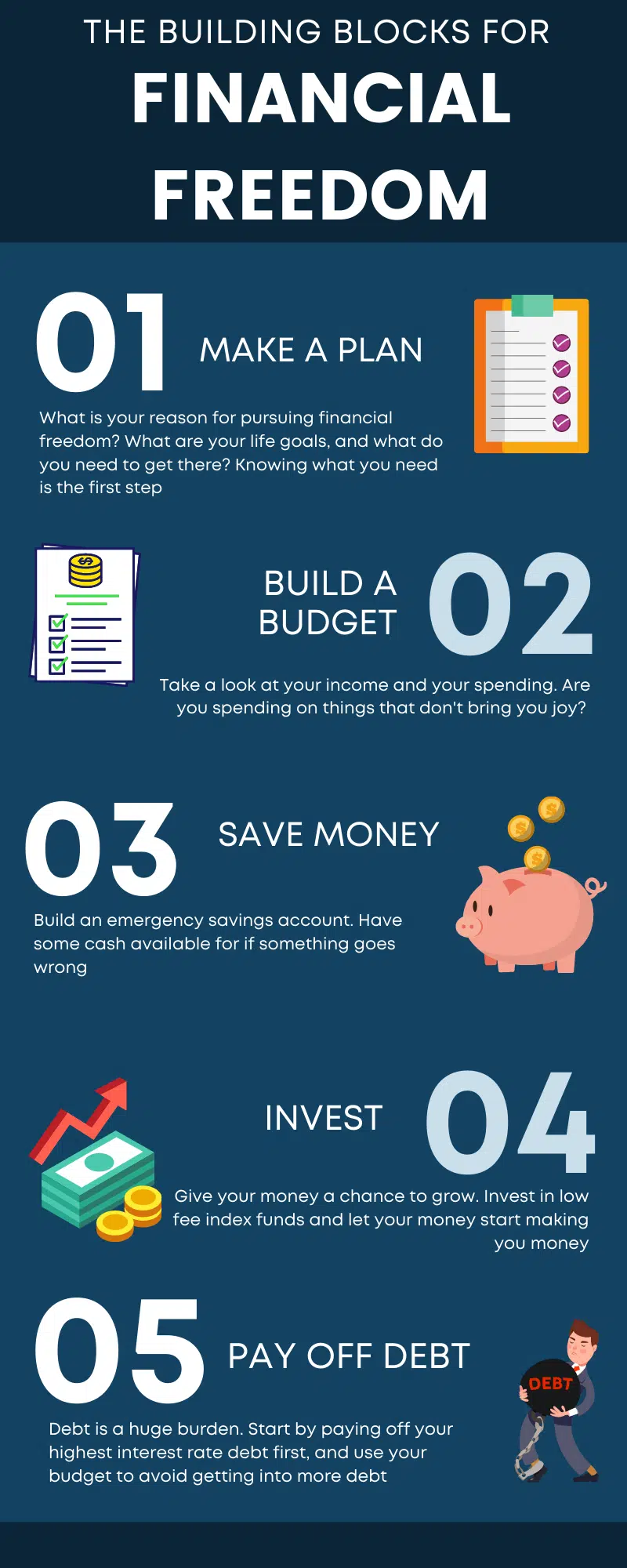
Let’s take a look at each in detail.
Making a Financial Plan

After you determine your life and financial goals, your next step is to make a plan to achieve them.
You will need to write out your current status and goals, then determine actionable steps you can take to achieve your goals.
Our Financial Freedom Mind Map Worksheet can help you with this, as can our epic post on building a financial plan.
You can also check out our YouTube video:
Building a Budget

Your financial plan is an essential building block to financial freedom. It will help you get into the correct headspace for achieving your goals.
But it’s a planning session. The first actionable step you need to take is building a budget.
Budgeting isn’t exciting or glamorous, and it can be downright dull. However, it needs to be done.
The basic premise of a budget is to manage your money rather than let your money control you.
It helps you visualize your spending, understand your subconscious priorities, and shift your expenditures, so they better align with your goals.
Budgeting also helps you find places where you’re needlessly spending money.
How to Budget

Because most expenses are monthly, it’s easiest to start with a monthly budget.
Write down all your expenses for the month. Include everything you buy, from dinners out to random snacks at the gas station, as well as your bills like rent or car payments.
Then, consider your annual or quarterly expenses, and divide them into monthly payments. Now you have an idea of all your monthly expenses.
Next, write down your income.
Hopefully, your income will exceed your expenses. If not, you may need to identify places to cut back or ways to increase your income.
Once you’ve found extra money in your budget, you get to tell it where to go. The next three building blocks of financial freedom are places you can put your money.
Saving

A healthy savings account is crucial to financial freedom. Your savings are your lifeline. It’s easily accessible cash in case of an emergency, or funding for some of your life goals.
Experts get a lot right here. You should focus on building an emergency fund first. However, the old adage that you need $1000 may not be appropriate.
If you have few expenses, you might be able to get by with a $500 emergency fund while focusing on a different building block. If you’re a homeowner with children, $1000 might not feel like enough.
The savings shouldn’t stop when you reach that first milestone. If you’re serious about financial freedom, you’ll probably want at least a year of living expenses in an accessible savings account.
How to Save Money

Your budget will help you save money. Hopefully, you’ve identified areas where you’re spending too much and can cut back.
If you need help, check out our epic resources on saving money:
- Save money on groceries
- Save money on living expenses
- Simple ways to save money
- Lifestyle changes that help you save money
Keep in mind, these savings don’t have to go into your savings account. You can use the extra cash for the other two building blocks of financial freedom, too.
Investing

A savings account is essential for financial freedom because it helps you fund short-term needs and provides a financial safety net.
Unfortunately, it’s not ideal for long-term goals like building wealth. Although interest rates on savings accounts have hovered around 3-4% for the last few years, it’s not enough to beat inflation. In addition, many of the big banks still only offer .01%! (side note – if your bank only offers .01% – consider switching).
Investing is the best way to beat inflation and grow wealth over time. I prefer investing in low-cost index funds because they offer automatic diversification and don’t take away too much of your hard-earned money in fees.
However, there are numerous other ways to invest. You can purchase individual stocks, real estate, and commodities, and you can even invest in yourself by starting a side hustle or building a business.
It’s best to diversify your investment portfolio to include a mix of different types of assets.
Check out our resource on investing for beginners for more information on how to start building your nest egg.
Paying off Debt
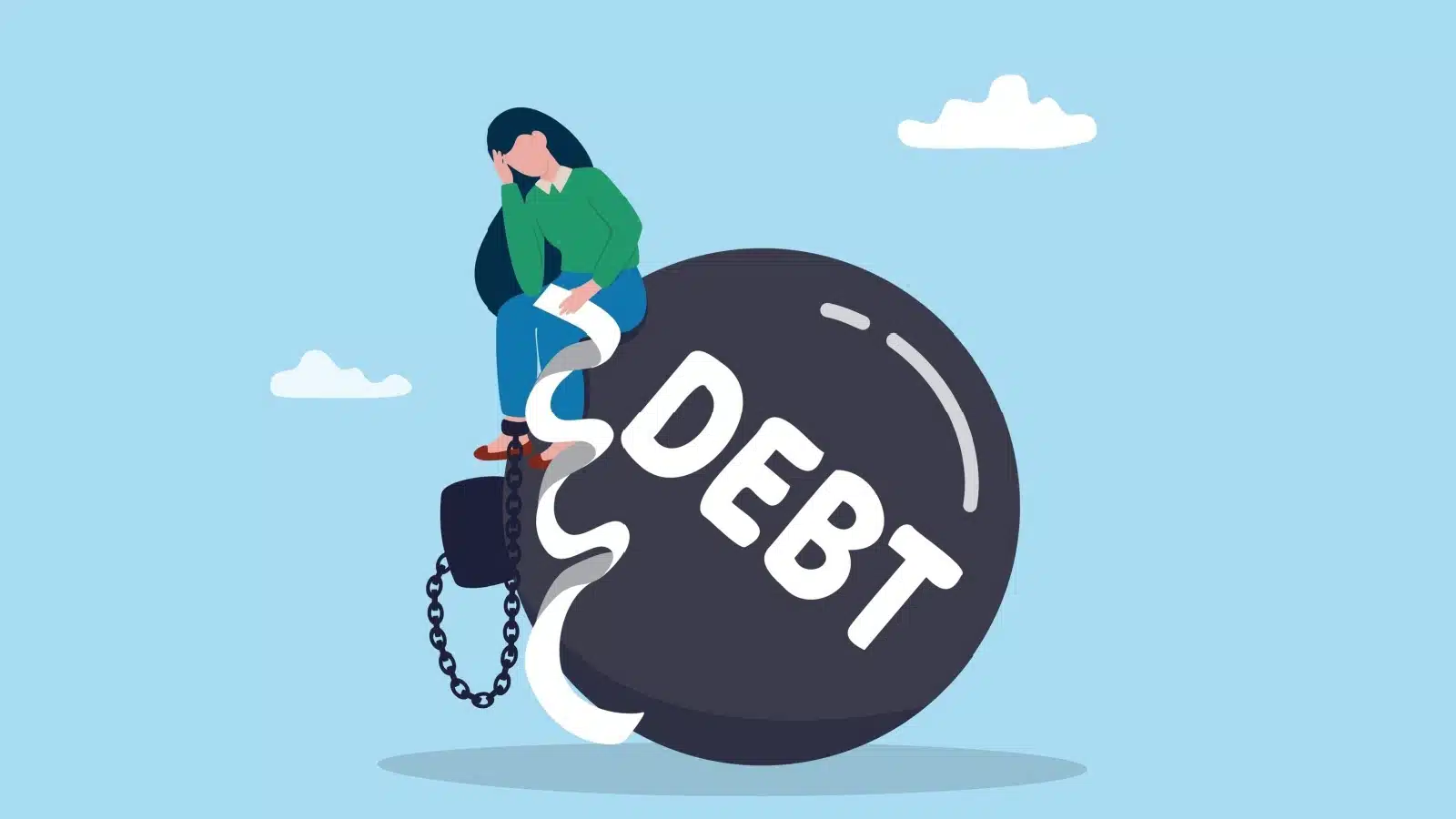
The final building block is debt repayment. Debt is like a ball and chain you carry around with you. It prevents you from pursuing new opportunities because you constantly have to focus on paying what you owe.
To get your debt under control, focus on paying off the account with the highest interest rate. Typically, this will be your unsecured credit card debt.
But paying them off won’t help if you keep charging. Put the cards away and promise yourself that you won’t use them unless there is an emergency and you have to.
Next, focus on student loan debt, which is a huge burden to an entire generation. Apply for loan forgiveness if you can, and pay as much as you can each month.
Finally, try to avoid getting into more debt. Save up for a new car and drive that beater longer. Work to build good credit before applying for a mortgage, or avoid buying a house if homeownership isn’t one of your big life goals.
What Should I Do First?

Experts will tell you that you should do these things in a specific order, and that’s where they’re wrong.
It’s impossible to tell you what to do first without knowing your specific goals. There is no financial order of operations that works for everyone.
One thing that most agree on is that you should try to get at least a thousand dollars in an emergency account first. That’s a great practice that will prevent you from losing all your progress if something goes wrong.
Some experts will tell you to focus on paying off debt next, but I disagree. It could take years to pay off thirty to forty thousand dollars of debt. You will miss out on compound interest and investment gains in those years if you focus solely on debt repayment, and a big emergency could wipe out $1000 in an instant.
So what should you do?
Use The Triangle Approach

Instead of focusing on one building block, consider all three. I call it the Triangle Approach to achieving your financial goals.
Let’s say you have a hundred extra dollars at the end of each month after making minimum payments on all of your debts and investing in your retirement account, and you have $1000 in your emergency fund.
What should you do with that extra $100?
Split it between the three pillars based on your financial goals!
My triangle currently has a small side for savings ($10), a small side for investments ($10), and a massive side for paying off debt ($80), because my top goal right now is to pay off my credit card. However, I’m still funding my savings account, because one vet trip or car repair will take my $1000 away in an instant, and I’m still funding my investment accounts because I don’t want to miss out on compounding interest.
You should build your triangle based on your own goals. If your top goal is improving your credit score to buy a house, focus on debt like I am. But if your credit is fine and you just need a down payment, focus on saving instead.
If you don’t care about owning a home and want to quit your job as soon as possible and live off investment income, you should focus more on building up your non-retirement investment accounts.
The beauty of the Triangle Approach is that it helps you build your debt-savings-investment triangle based on your individual goals – a crucial point no other financial guru even takes into consideration.
But What About Traditional Retirement?

Did you catch that tiny little statement: after investing in your retirement account?
You must put something aside for traditional retirement, whether you’re pursuing financial independence or not.
It’s even more vital if you work for a company that offers a match. Invest enough in your traditional retirement account to get the full match. No other investment on the planet offers that type of guaranteed return.
Even if you don’t get a match, investing for traditional retirement before investing for early retirement is crucial. The government offers a variety of tax-deferred programs to make it a good financial decision today, and because life often throws us curveballs, it’s best to have the financial security of a growing account no matter what happens.
I reached Coast FIRE, a crucial milestone on my path to financial freedom, before I turned 40, because I regularly invested in traditional retirement accounts.
Is Financial Freedom Possible in Five Years?
Some people can achieve financial freedom in five years, and others can’t. Whether you can or not depends upon your individual situation and your goals.
If you have a super high income and low expenses, you could invest all your extra money and grow enough wealth to quit your job in five years. If you have a low income or lots of expenses, it might not be feasible.
In addition, achieving financial freedom is more possible in five years if you’re pursuing a path that still provides an income. For example, I consider working for myself, doing what I love, a form of financial freedom. My Passion Fire lifestyle should be attainable in five years if I start building it now and make smart financial decisions.
However, if you desire a fat fire lifestyle and are just starting with an average income, five years might not be enough.
The timeline depends on your personal goals and current situation.
How Much Money Do I Need for Financial Freedom?

The big question is, how much money do you need? And, like anything, that depends on your goals.
People love to throw out numbers, like a million dollars, and say that’s what they need, but if you haven’t done the math, you shouldn’t count on it.
Some people could achieve financial freedom with less than a million dollars, while others need much more.
Take a hard look at your goals and what you need to get there. Our article on how much money you need will help you get started.
Financial Freedom is Achievable

There is so much to the financial independence movement that some type of FIRE is available to most people. Follow the road map in your own financial plan, and you will get there in no time!